

Abraham-Hicks introduced the Focus Wheel in the mid-1990s. Talked about it constantly for a few years. Then moved on to other processes, the way they always do.
Except this time, something unusual happened.
Years later, Abraham re-introduced Focus Wheels back into their seminars. As far as I'm aware, that has never happened with any other process they've taught. Not before, not since. They brought back exactly one method.
I've been using Focus Wheels since that original mid-90s introduction. Nearly three decades now.
And I can say with complete confidence that the Focus Wheel Process is probably the most powerful deliberate focusing method that exists for changing how you feel about any subject.
I still use them. I'm still amazed at the effectiveness of them. If you were to learn no other vibrational process and apply this one consistently, you would rapidly transform your life.
Bold claim, I know. But I've had roughly thirty years to test it.
The strange part? Most people who try Focus Wheels conclude they don't work.
They sit down, draw the circle, write their statements, and end up feeling worse than when they started. Then they shelve the whole thing and move on to the next shiny method.
The problem isn't the process. The problem is one specific misunderstanding about how the wheel functions. One thing that almost nobody explains properly, and it changes absolutely everything about whether this method works for you or becomes an exercise in self-inflicted frustration.
Not a Staircase
Let me describe the mechanics first, for anyone who has heard the term "Focus Wheel" but hasn't actually tried one.
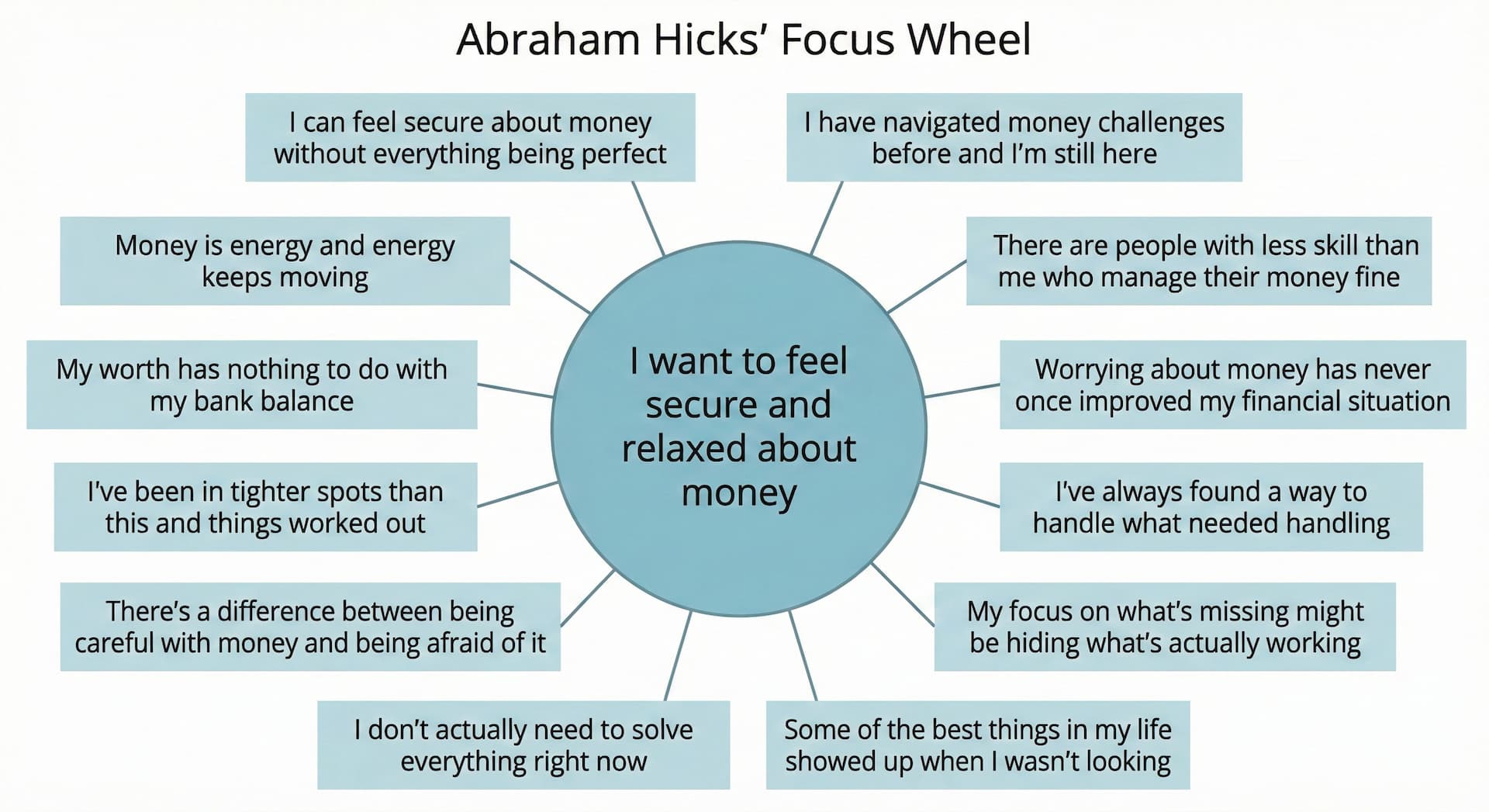
You draw a circle. In the centre, you write how you want to feel about a subject. Not what you want to happen. How you want to feel. So not "I want £50,000" but "I want to feel secure about money." The feeling is the target.
Then you draw 12 lines radiating out from the circle, like the positions on a clock. Starting at one o'clock, you write a statement that gives you a little bit of genuine relief about that subject. Something that makes you feel even slightly better than you did before you picked up the pen. You fill in two o'clock, three o'clock, and so on around the wheel.
That's it. That's the whole structure. Abraham devised it as a way to deliberately shift your feeling about any subject into a better place, and when you understand the one thing most people get wrong, it works astonishingly well.
If you've never seen a Focus Wheel in action, the following video is a good introduction. You won't learn the full mechanics from this video alone, but you'll see what they look like and get a feel for the process:
Here's the thing most people get wrong.
They assume each statement has to feel progressively better than the previous one.
- Statement one gives a tiny bit of relief.
- Statement two should feel even better than statement one.
- Statement three better than statement two. An ascending spiral, each step taking you higher.
- By about statement six they're straining.
- By nine they're lying to themselves.
- By twelve they feel worse than when they started and they decide the method is rubbish.
I did this myself for ages before I figured out what was actually happening.
A Focus Wheel is not an ascending wheel. It's a holding wheel.
Each statement doesn't need to feel better than the one before it. It just needs to feel better than where you were before you started the wheel. That's the whole game.
Statement four might not feel better than statement three. It might feel about the same as statement two. Fine.
Statement three might not feel better than statement two, but it should at least feel better than statement one.
The statements aren't climbing. They're holding you in place.
That's what makes it work. The point isn't to rocket yourself into ecstasy over twenty minutes. The point is to hold yourself in a slightly-better-feeling place for long enough that your vibration actually shifts.
Your Vibration Stays Where You Leave It
There's a principle I confirmed to myself again and again over the years, and it's the thing that makes Focus Wheels compound over time: your vibration on any subject stays where you last leave it.
So if you spend twenty minutes held in a better-feeling place on any subject, the next time you encounter that subject, whether that's tomorrow or next week, you're starting from that new baseline. Not from where you were originally. The wheel moved the needle, and it stays moved.
I remember the first time I really noticed this. I'd done a Focus Wheel on a financial worry. Felt a bit better afterwards but nothing dramatic. Put it aside.
About four days later, the same worry came up and I braced myself for the usual gut-clench. It didn't come. Not fully, anyway. The worry was still there, but it had lost some of its punch. The wheel had done something underneath the surface, even though I hadn't touched the subject since.
That's when I started to understand what twenty minutes of sustained, slightly-better-feeling focus actually does. It's not that any individual statement is life-changing. It's that holding a feeling for that long rewrites your default on that subject.
Your brain starts noticing evidence for the relief instead of evidence for the worry. The Law of Attraction brings more thoughts that match the new feeling. The snowball rolls.
Most people try to use Focus Wheels like a rocket ship, hoping to blast from depression to joy in a single session. That's like trying to jump from the ground floor to the tenth floor of a building.
What Focus Wheels actually do is give you a really stable platform on the second floor. Once you're stable there, the third floor becomes much easier to reach. And then the fourth. Each wheel builds on the last.
Actually Doing A Focus Wheel
Right, let me walk through an actual Focus Wheel so you can see the difference between statements that work and statements that fail. I'll use money, since most people have some charge on the subject.
Centre of the wheel: "I want to feel secure and relaxed about money"
Starting emotional state: frustration and worry.
Before writing anything, you need to get honest about where you actually are. Not where you think you should be, not where you were last week.
Where you are right now, reading that centre statement. Do you feel a stab of anxiety? A dull resentment? A tight feeling in your chest? Whatever it is, acknowledge it. Because the statements you write need to be better than that feeling. Not better than some idealised version of how you wish you felt.
Statement 1: "I have navigated money challenges before and I'm still here"
Gives a little relief. It's true. No wild leap. Just acknowledging something real that feels slightly better than the worry.
Statement 2: "There are people with less skill than me who manage their money fine"
Another angle of the same basic relief. Not necessarily better than statement one. Just a different foothold at roughly the same level.
Now. Here's a statement that would not work: "I am abundant and money flows to me effortlessly"
That's a head-on affirmation. If you already believed it, you wouldn't need a Focus Wheel. Writing it when you don't feel it, your gut immediately says no, that's not true. You've just added resistance on top of resistance instead of finding relief.
I saw this distinction play out brilliantly during one of my webinars. We were experimenting with ChatGPT, getting it to generate Focus Wheel statements for someone who felt they spent too much money on fancy watches.
ChatGPT produced ten statements and some were surprisingly good.
"Investing in quality items that bring me pleasure is a valid choice" gave genuine relief.
But "my financial decisions are thoughtful and responsible" was too head-on. If the person already believed their financial decisions were responsible, they wouldn't be writing a Focus Wheel about their watch habit 🙂
The truth is that only you can tell whether a statement gives you genuine relief. No book, no AI (ironic, given the ChatGPT experiment), no teacher can evaluate that for you.
It's an internal feeling. A subtle softening, a slight easing of tension, an "oh yeah, that's actually true" kind of sensation. Not excitement. Not joy. Just a small release of pressure. That's what you're looking for.
If you read a statement back and feel nothing, it's not working. If you read it and feel a slight tightening, it's making things worse. If you read it and something loosens just a fraction, even a tiny fraction, that's relief. That's a keeper.
Continuing around the wheel:
Statement 3: "Worrying about money has never once improved my financial situation"
Statement 4: "I've always found a way to handle what needed handling"
Statement 5: "My focus on what's missing might be hiding what's actually working"
Statement 6: "Some of the best things in my life showed up when I wasn't looking"
Statement 7: "I don't actually need to solve everything right now"
Statement 8: "There's a difference between being careful with money and being afraid of it"
Statement 9: "I've been in tighter spots than this and things worked out"
Statement 10: "My worth has nothing to do with my bank balance"
Statement 11: "Money is energy and energy keeps moving"
Statement 12: "I can feel secure about money without everything being perfect"
None of these are escalating toward "I'm a millionaire."
They're just twelve slightly different angles on the same basic idea: things aren't as bad as my worry is making them feel. Each one is something you could actually believe. Each one feels at least a bit better than the original worry.
That's a working Focus Wheel.
One thing worth mentioning. If you get to statement seven or eight and genuine relief stops coming, stop. Put the pen down.
Eight authentic statements are worth infinitely more than twelve where the last four feel forced. Your vibration knows the difference even when your conscious mind is trying to pretend otherwise.
And once you've finished (or gotten as far as relief will take you), put it aside. Let it settle. Don't immediately try to do another wheel on a different subject. Give the vibrational work time to integrate.
I'd leave a few hours between wheels. Trying to do five or six in a row is like trying to change the direction of five different trains at once.
Here's a good example of Abraham walking someone through a Focus Wheel on finding a partner. Watch how they find relief statements that are genuine rather than aspirational:
Where Most Frustrations Come From
I've been teaching this for years and the same mistakes come up over and over. Let me run through the ones that cause the most grief, because knowing what not to do is almost as important as knowing what to do.
The biggest one I've already covered: trying to make each statement better than the last. That's the killer. But there are others.
Writing what you think you should feel instead of what actually gives you relief.
- "I trust the universe completely" when you're terrified.
- "Everything always works out perfectly" when your evidence suggests otherwise.
These sound good on paper but they don't produce that internal loosening. They produce resistance. Be real about what actually gives you relief, not what sounds spiritual or advanced.
The next biggest problem is trying to use Focus Wheels from too far down the emotional scale.
This one causes more confusion than anything else, because people think Focus Wheels are a panacea. They're not. They work from anger upwards.
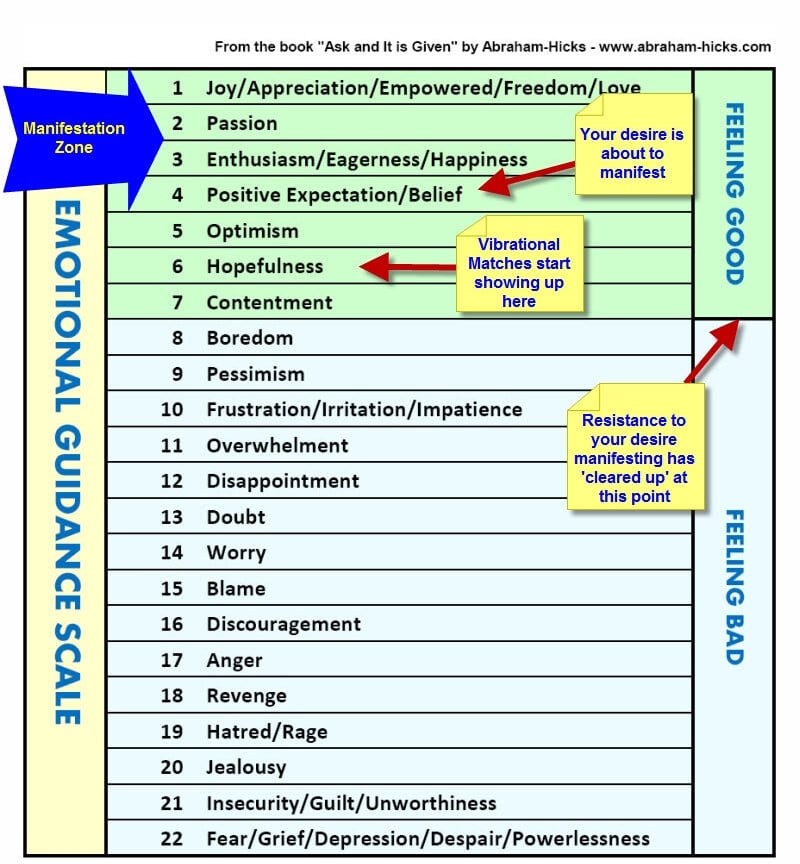
If you're frustrated, irritated, overwhelmed, worried (check the diagram above) they will shift you beautifully.
But if you're in depression, grief, or despair, the vibrational gap is too wide. There isn't enough guidance in those statements to bridge from depression up to anger. You'll try, nothing will shift, and you'll conclude the whole thing is broken.
It isn't broken. You're using the wrong tool for the job.
Like trying to tune a guitar with a sledgehammer. The sledgehammer isn't defective. It's just not what you need right now.
If you find yourself below anger, use other methods first. Meditation can work. EFT can work. Sometimes just going for a walk and thinking about neutral things shifts you enough that a Focus Wheel becomes effective.
One more that catches people who've had some initial success: doing too many too fast. When people first discover how well they work, they try to do five or six in a row on different subjects, like clearing a backlog.
It doesn't work that way. Each wheel needs space to settle. One subject, one wheel, let it integrate. Come back to a different subject later in the day or tomorrow.
What Happened When I Couldn't Be Bothered
(The Focus Blocks Method)
The Focus Blocks story starts, like most things in the Manifesting Lab, with me being too lazy to do things properly 
There is an underlying theme with my methods. I'm too lazy to do them the way they're designed, so I come up with easier and less intensive ways of achieving the same things. Focus Blocks might be the most dramatic example of this.
Back in the mid-'90s I was trying to use Focus Wheels regularly. A proper Focus Wheel takes about twenty minutes. You sit down, concentrate, write twelve genuine statements on one subject. Abraham advocates staying with that subject for the full twenty minutes until you finish it.
I've got things to do, people to see, dogs to walk ...okay, I don't have a dog but you get the idea.
I'd write three or four statements, feel some relief, and think, I can't be bothered to do any more on this. I'd leave the wheel unfinished.
Piles of them. A wheel on money with four statements. One on relationships with six. Another on health with just three. Different subjects, scattered around in notebooks, all partially completed. Not exactly the disciplined Abraham approach.
Then something interesting started happening.
When I came back to an unfinished wheel days later, sometimes even a week later, I could pick up exactly where I left off. The previous statements still worked. I could read through them, reconnect with the feeling, and write the next one as if I'd only just put the pen down. My vibration on that subject had stayed where I last left it. I didn't have to start over.
So that principle, the one about your vibration staying where you last leave it, I was proving it to myself over and over again with these abandoned wheels.
And it got me thinking. What if I didn't need to complete entire wheels? What if I just wrote one or two statements on money, got a bit of relief, then jumped to a statement or two on health, then hopped over to relationships?
Each little bit of relief on one subject made it easier to find relief on the next. The good feeling from the money statement spilled into the health statement. Health spilled into relationships.
I was bouncing between subjects, adding one or two statements to each, and with each bounce I'd feel better and better. Within minutes I could go from feeling generally irritated about life to being in what Abraham calls The Vortex. That pure aligned state where everything flows.
Something important had happened. I'd accidentally created a completely different method.
Focus Wheels shift your vibration on a single subject. What I was doing, this bouncing, was a way to get into the Vortex fast by springboarding off multiple subjects in quick succession.
It was like each micro-hit of relief propelled me into the next one, and the next, until the momentum carried me into alignment almost automatically.
These weren't really Focus Wheels anymore. They were snippets of Focus Wheels, arranged in blocks. Focus Blocks.
To people who look at this casually, it seems like a Focus Wheel just rearranged into a list format.
It isn't. The mechanics are completely different.
A Focus Wheel works on one subject for twenty minutes. Focus Blocks bounce between dozens of subjects in seconds, using the relief from each one to power the next. Same foundation, completely different application.
By the mid-2000s, after about ten years of messing about with different bits of software, I'd given up trying to make existing tools work and built the thing myself in Microsoft Excel. Custom VBA code. Yuck ...painful but necessary.
Hundreds of Focus Blocks. Every little niggly thing in my life dumped into what became known as the "vibrational spreadsheet."
I didn't call it Focus Blocks at the time. I just noticed this pattern, and every time I followed the pattern I would feel good, regardless of how bad I was feeling to begin with.
The computer would randomly present different blocks. I'd add a statement if relief came, bounce to the next one.
I used to joke on Inward Quest: "I control the Universe through an Excel spreadsheet."
And the funny thing is, it was true.
Stuff was manifesting, often things I wasn't even actively working on. That consumed about a decade of fine-tuning before I understood what was actually happening.
Along the way, I created this website to help others understand it too ...Manifesting Lab.
Today I can explain it clearly: maintaining the Vortex frequency consistently is what does the manifesting, not any specific method. The Focus Blocks just gave me a reliable way to hold that frequency, every day, without needing twenty uninterrupted minutes for each subject.
The Focus Blocks Method doesn't replace Focus Wheels. It enhances how you use them. But you need to be comfortable and effective with regular Focus Wheels first, because that's the foundation everything else builds on. The wheel is the engine. Focus Blocks just put it on a different chassis.
You can read about The Focus Blocks Manifesting Method in detail here.
So That's How It All Happened
So let's sum it all up.
- The Focus Wheel Process is awesome
 ...and anyone who wants to get involved with deliberately focusing their thoughts into better places should really spend the time getting to grips with it.
 - It's a holding wheel, not an ascending wheel.
- Your statements just need to feel better than where you started. Twenty minutes of sustained slightly-better focus shifts your baseline on any subject, and that baseline stays shifted because your vibration stays where you last leave it.
- Only use them from anger upwards on the emotional scale.
- And genuine relief, that subtle internal loosening, is the only measure of whether a statement is working.
Draw a circle. Write how you want to feel in the centre. Find one statement that gives you genuine relief. Then another. Take your time with it.
Let the relief be real. That's the whole secret.
Photo by Internet Archive Book Images