
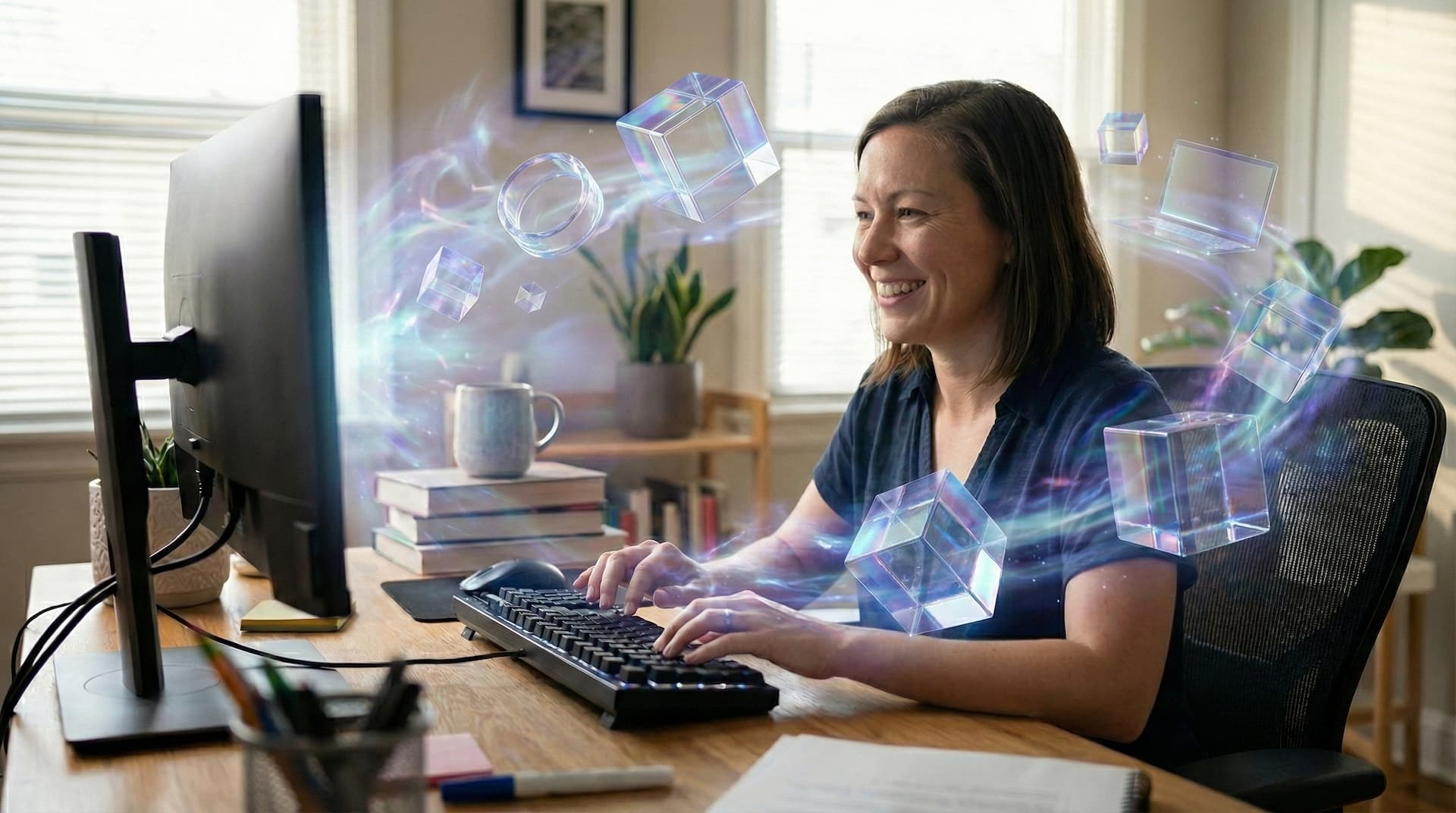
Most people who take manifesting seriously have a complicated relationship with technology. There's this lingering idea that real vibrational work should involve handwritten journals, vision boards cut from magazines, and maybe some candles.
Something about pen on paper just feels more spiritual, right?
I used to think something similar. Then I spent a few decades actually testing what works — and what I discovered might surprise you.
The truth is, I tend to think of computers as very spiritual, mystical things. The data doesn't really exist — it's just electrons in different formats that a machine can interpret.
And yet that digital form is more material than a thought floating around in your head. That materialization, even in something as abstract as pixels on a screen, is enough for us to more concretely interact with our desires.
Let me explain why that matters more than you think.
The Power of Getting It Out of Your Head
Here's something I've observed over and over again, both in my own practice and in watching others: the human mind is an exceptional thought generator and an exceptionally poor thought processor.
You can sit there and think about what you want, convince yourself you've really focused on it, and then go about your day having achieved almost nothing vibrationally. The thought just loops endlessly — a vague, amorphous blob that never quite resolves into anything useful.
But the moment you're forced to externalize that thought — through your fingers, onto a screen — something shifts. You have to focus enough to give form to the thought, and that act of focusing is itself a kind of amplification.
It's like a pendulum effect. The thought gains clarity simply because you had to wrestle it into words, and once it's externalized, it's out of that endless loop. For a period of time, you feel genuine relief. You feel lighter. And that relief? That's a vibrational shift, which is the whole game.
This is why writing things down — whether on paper or a screen — gets stuff out of your mind. When it's just floating around in your head, you can't look at it objectively.
You can't see where you're in presence and where you're drifting into absence. You can't troubleshoot your own vibration when you're swimming in it.
But externalize it, and suddenly you're wearing the lab coat, looking at your thoughts from the outside. Now you've got distance. Now you can actually work with the material.
And here's the thing that Abraham themselves confirmed when asked directly about typing versus handwriting: it depends on the person.
For some people who grew up with pen and paper, there's a stronger neural connection through handwriting. But for people like me — and I suspect a growing number of people raised with keyboards — typing creates the same depth of connection.
I've been using typewriters and keyboards since I was a tiny kid, pressing keys on clunky machines with paper and ink. For me, handwriting and typing operate on nearly the same level vibrationally.
The manifesting community's insistence that you must handwrite everything is one of those unexamined assumptions that simply isn't true for everyone.
What matters isn't the tool. It's whether you're genuinely engaging with the vibration as you use it.
Your Screen Is a Vibrational Canvas
Now, once you accept that technology is a perfectly valid medium for vibrational work, some interesting possibilities open up.
Consider what you're actually doing when you sit down at a computer and start writing out a story of your desired future — what some call scripting.
To other people, you're just typing. But you're not.
You are literally doing almost the most incredible thing a human being can do: taking pure abstract thought and condensing it, on purpose, into a progressively more material form.
The words on the screen are just a placeholder — a holder for your vibration. The mystical books talk about the power inherent in words, how the word is the beginning of everything.
What they're really talking about is the essence of the vibration. The word itself, whether scribbled on paper or glowing on an OLED screen, is just the container. You are the one filling it with vibrational content.
And technology actually gives you some advantages here that paper doesn't.
Mind mapping software, for instance, lets you brainstorm and organize the components of a desire in a way that's visual and fluid. You can start with your broad desire, branch out into the specific aspects — the what, the why, the how it feels — and then rearrange those branches as your understanding deepens.
I use mind mapping software regularly for vibrational work because it lets me see the structure of a desire at a glance, and I can feel immediately where I'm in presence and where something needs cleanup.
Note-taking apps serve a similar purpose. When you build a Virtual Vortex — a collection of things that make you feel good, including virtual realities, touchstones, positive aspects — having it on your phone or computer means it's always accessible.
You can pull up a scene you've written, a touchstone that shifts your state, or a gridwork entry that needs a bit more momentum, whether you're at your desk at seven in the morning or lying in bed at midnight.
The accessibility itself removes friction from the practice, and less friction means more consistency, and consistency is what actually builds manifesting skill.
Artificial Intelligence Assistants
Even AI tools have started showing up as potential aids. Some people use conversational AI as a kind of vibrational assistant — running through focus statements, exploring the feeling place of a desire, or even working through resistance.
Now, I want to be careful here because this falls squarely into the category of a permission slip, to use Bashar's term.
The AI isn't doing the vibrational work. You are.
But if interacting with it helps you externalize your thoughts, gain clarity, and find relief, then it's serving exactly the same function as any other manifesting tool. Just don't fall into the trap of thinking the technology itself has magical properties.
It doesn't. You do.
And that brings me to what I think is the most important point in all of this. There's a temptation, especially for technically-minded people, to get so fascinated by the tools that you forget what you're actually doing with them.
You can build the most elaborate digital system — spreadsheets tracking vibrational matches, databases of desires, automated reminders to do your gridwork — and achieve absolutely nothing if you're not engaging with the feeling behind it all.
The tool is like that magnifying glass I often talk about. It can be used to read what's on the paper, which in our analogy is manifesting — a presence-based activity. Or it can be used to focus the sun's rays and set fire to the paper, which is an absence-based activity. Same tool, completely different outcomes depending on the intent of the person using it.
A computer screen full of beautifully formatted desires that you wrote from a place of absence — longing, desperation, needing it to work — is worse than a crumpled napkin with three words scrawled on it that you wrote while genuinely feeling the presence of what you want.
Never confuse the sophistication of the tool with the quality of the vibration flowing through it.
Big Deal. So What?
So what's the practical takeaway?
Use whatever technology feels natural to you.
If typing on your phone helps you externalize and clarify your desires, do that. If mind mapping software helps you see the structure of what you're creating, use it. If a note-taking app means you actually do your vibrational work every day instead of skipping it because your journal is in another room, that consistency alone is worth more than any mystical advantage handwriting might theoretically offer.
The practice of manifesting is a lot like learning a musical instrument. You wouldn't insist on only ever practicing on a vintage acoustic when an electric guitar is sitting right there and feels better in your hands.
The instrument doesn't make the music. The musician does.
And you are the musician — the vibrational artist — whether your canvas is a sheet of paper, a smartphone screen, or an app running on a laptop.
What matters is what's going on in your mind as your fingers move. The thoughts, the feelings, the subtle interplay of presence and absence that you're learning to navigate with increasing skill.
Technology doesn't make manifesting easier in the way people hope — there's no app that will vibrate for you.
But it can remove friction, encourage consistency, help you externalize and organize your thoughts, and make your vibrational tools accessible when you need them most. And sometimes, that's the difference between someone who practices every day and someone who means to practice every day but never quite gets around to it.
Let's Sum It Up
So there you have it.
Your keyboard, your phone, your favorite note-taking app — they're not distractions from your spiritual practice.
Used with the right intent, they are your spiritual practice.
Just remember that you're not really typing words. You're molding energy, word by word, sentence by sentence, into the shape of the reality you want to inhabit. The screen is just where you happen to be doing your sculpting today.